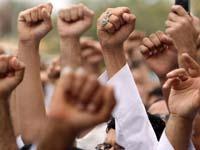
Many democracies have allowed their ties with repressive allies to temper their support for human rights in the Arab Spring protests.
For reasons of principle and long-term interest, governments should stand firm with the people of the Middle East and North Africa when they demand their basic rights and work to ensure the transition to genuine democracies.
The people driving the Arab Spring deserve strong international support to realize their rights and to build genuine democracies.
Loyalty to autocratic friends shouldn’t stand in the way of siding with democratic reformers. International influence is also needed to ensure that the new governments extend human rights and the rule of law to all, especially women and minorities.
A principled insistence on respect for rights is also the best way to help popular movements steer clear of the intolerance, lawlessness, and revenge that can threaten a revolution from within.
The repercussions of the Arab Spring have been felt around the world.
Leaders in China, Zimbabwe, North Korea, Ethiopia, Vietnam, and Uzbekistan seem to be living in fear of the precedent of people ousting their autocratic governments.
But even democracies such as India, Brazil, and South Africa have been reluctant to support change.
Relying on outmoded views of human rights promotion as imperialism and ignoring the international support that their own people historically enjoyed when seeking their rights, these democracies often failed at the United Nations to stand with people facing repression.
China and Russia have been even more obstructionist, vetoing efforts at the UN Security Council to build pressure on Syria to stop killing thousands of demonstrators. Their ostensible reason –avoiding a Libya-like military intervention – rings hollow when the modest resolution they vetoed could not possibly be read to authorize military action.
The Human Rights Watch World Report 2012 documents human rights abuses worldwide, including: violations of the laws of war in Libya and Afghanistan; the plight of political prisoners in Vietnam and Eritrea; the silencing of dissent in China and Cuba; internet crackdowns in Iran and Thailand; killings by security forces in India and Mexico; election-related problems in Russia and the Democratic Republic of Congo; mistreatment of migrants in Western Europe; neglectful maternal health policies in Haiti and South Africa; the suppression of religious freedom in Indonesia and Saudi Arabia; torture in Pakistan and Uzbekistan; discrimination against people with disabilities in Nepal and Peru; and detention without trial in Malaysia and by the United States.
One welcome advance was the adoption of an international treaty to protect the rights of domestic workers.
Domestic workers are especially vulnerable to abuse, but many countries exclude them from labor laws and other protections. The new treaty guarantees the basic rights of millions of migrants who work in private homes as nannies, housekeepers, and caregivers.
The events of the past year show that the forced silence of people living under autocrats should never have been mistaken for popular complacency.
Rights-respecting governments should support international justice regardless of political considerations.
It’s misguided to believe that allowing countries to sweep past abuses under the rug will somehow avoid encouraging future atrocities.
As we mark the first anniversary of the Arab Spring, we should stand firmly for the rights and aspirations of the individual over the spoils of the tyrant.
Excerpted from Human Rights Watch’s annual review of human rights practices in more than 90 countries.
Add new comment