By Wenran Jiang
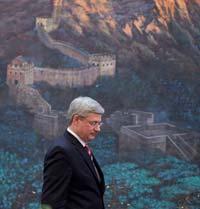
Prime Minister Stephen Harper’s second visit to China last week began with a picturesque visit to Beijing’s Temple of Heaven, where Chinese emperors used to hold ceremonies for good harvests. Good harvests were what the PM got in his first day of business, signing nine bilateral economic co-operation and trade agreements. The most anticipated was the conclusion of the Foreign Investment Protection Agreement (FIPA), after nearly two decades of negotiations.
While genuine concerns are understandable regarding the Chinese investment in Canada, some critics have lashed out at the entire process of closer economic ties between the two countries. They claim that the inflow of Chinese capital will lead to the takeover of Canada by China, that Canada’s foreign policy is now made in Beijing, that Chinese companies are all corrupt with evil intentions of destroying Canadian jobs, and that any Canadian companies doing business with China are in bed with the devils as well.
These charges are total nonsense. They are not just crying wolf but flagging the coming of a new “Yellow Peril” under the disguise of protecting Canada from China’s one-party dictatorship and poor human rights records.
The Chinese investment in Canada has grown significantly in recent years, but its overall scale pales in contrast to American and European investment.
None of Canada’s economic sectors are dominated, or even close to being controlled by Chinese money.
Yes, the Chinese national oil companies have put in some $16 billion into our energy sector in the past two years, but globally, they have done much larger deals in other resource rich states. In a single deal with Russia, Chinese national oil companies (NOCs) and banks invested $25 billion in exchange for multi-decade oil and gas supply agreements.
In Australia, China sealed multiple long-term energy supply agreements, each worth tens of billions of dollars. Kazakhstan, Venezuela, the list goes on ... Canada has no such large dealings with the Chinese and hopefully the signing of FIPA will change that.
In whatever ventures the Chinese have invested in Canada, they have followed our laws and regulations. It is true that most of Chinese investment in Canada is from state-owned enterprises (SOEs) but they cannot be simply labelled as agents of the Chinese Communist Party, operating on a different set of rules. All internationally operated Chinese SOEs are listed in foreign stock exchanges, thus being monitored by international standards. Under these international subsidiaries of Chinese SOEs, Canadian subsidiaries are formed locally, thus following an additional set of federal and provincial regulations. It is impossible that any of the Chinese companies, now or in the future, will be able to “take over” any of our industrial sector, let alone “take over” Canada.
To the contrary, Chinese ventures or joint ventures have created jobs, sustained our economic growth, and paid taxes and royalties. They have not demanded the output be shipped back to China as a condition of their investment.
China is changing at a fast pace and growing more complex. It is not a monolithic bloc. Nor is Chinese companies’ behaviour.
The increasing amount of Chinese capital in Canada has given extra incentives for the Chinese SOEs to perform well, and they are fully aware of the ongoing debate in Canada regarding the scope of Chinese investment.
Rather than limiting our economic interactions with China out of fear or Sinophobia, we should be confidently encouraging the Chinese enterprises, state-owned or private, to invest more in Canada while making efforts to make our own companies competitive in the Chinese market.
We can also work with the Chinese ventures in Canada with a “demonstration effect,” that is to showcase how transparency, rule of law, environmentally friendly practices can be implemented in China for its own long-term growth and prosperity.
The real challenge is not that we have too much Chinese investment but too little.
Wenran Jiang is political science professor at the University of Alberta and Senior Fellow with the Asia Pacific Foundation of Canada.
Add new comment