How do recent immigrants in British Columbia relate to the Fraser River, the biggest body of water in the province?
How does their experience of BC rivers connect to their memories of water bodies in their home countries?
These are some of the exploratory questions that inspired Dr Leonora Angeles, head of the “Rethinking Responses and Responsibilities in River Regions” Social Justice@ UBC Network to invite Dr Merlinda Bobis from the University of Wollongong to perform her one-woman play “River, River” in Vancouver.
The Social Justice @UBC Network based at the Institute for Gender, Race Sexuality and Social Justice connects humanities, social science and natural science researchers like Professors Sneja Gunew and Chris Lee of English, Juanita Sundberg and Gerry Pratt of Geography, Leila Harris of Resources and Environmental Studies, and graduate students from the Philippine Studies Series at the Liu Institute for Global Issues.
For its community partners, the Network invited the Canada-Philippine Solidarity for Human Rights, the BC Migrante, and the Pilipino Artists Network for Community and Integrative Transformation (PANCIT) to connect the project to the third largest “visible minority” group in Canada.
Professor Angeles said, “While we know much about how BC First Nations peoples’ historic and economic relationship to the Fraser River, we know little about newer immigrant communities connect with this major lifeline and resource in our province. I would like the Filipino community in Metro Vancouver in particular to reflect on our collective response and sense of responsibility for the Fraser River.”
The diminutive professor of Community and Regional Planning and Gender Studies at UBC also heads the SSHRC Partnership Development project on Collaborative Governance of Urbanizing Watersheds. “I see a lot of parallels in the Network and my recent SSHRC project on Angat River in Bulacan whose residents are called Tagalog from the root word ‘taga-ilog’ or river dwellers,” she said.
“Angat River supplies 97% of domestic water needs in Metro Manila and almost 100% of irrigation water in two provinces. But the River is dying. Is it possible for people in BC and in Bulacan to create global-local connections to conserve our water resources, especially in the face of climate change? Can we foster a transnational and inter-cultural understanding of indigenous peoples and local settlers whose lives and livelihoods are intimately intertwined with the life of rivers and watershed regions? We are wondering in the Network if the Arts can partly provide the answer.”
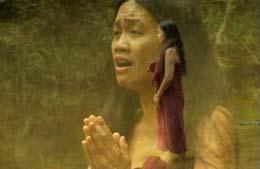
In Bobis’ theatrical adaptation of her critically acclaimed novel, Estrella Capili, the Fish-Hair Woman uses her twelve-metre hair to trawl corpses from the river in Iraya, a militarised village in the Philippines’ Bicol Region.
It is 1987 and “Total War” military campaign is declared by the government to purge insurgency in the countryside. The river becomes the dumping ground of victims of summary executions, and the metaphor for memory and myth-making.
This cross-genre play is storytelling, drama, poetry, ritual, and music: the traditional chanting style of the Bitabara family, the composition of Sarah de Jong, and the chanting ritual of the Pasyon, or The Passion of Christ.
Dr. Merlinda Bobis is a trilingual writer, performer, and academic. She has published three novels, a collection of short stories, five poetry books, a monograph on creative research, and scholarly essays on creative-critical production, militarism, migration, and the transnational imaginary.
Her words received various awards, among them the Prix Italia, Australian Writers’ Guild Award, and Ian Reed Prize for her radio play Rita’s Lullaby.
She teaches creative writing at University of Wollongong, Australia.
She will be a visiting scholar in residence at the UBC St John’s College. Copies of her books are available at the UBC Bookstore.
“River, River” will be shown on October 25, Friday at the UBC Telus Studio Theatre from 6:30-7:30 pm with an Artist-Network talk and cocktails following the performance. Admission is free but donations to the three community partners are welcome. More information email riverivernetwork@gmail.com, or go to Twitter page @river_network.
Add new comment