By Victoria Fawkes
Special to The Post
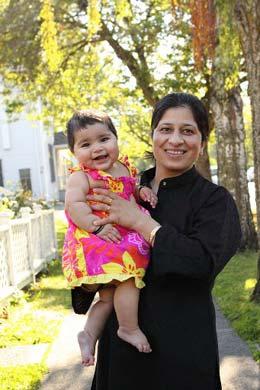
When Samina Habib and her husband Sajad learned their local hospital had classified Samina’s pregnancy as “high risk” and that she would have to be transferred to Royal Columbian Hospital (RCH), they were fearful about what to expect.
Samina, who was pregnant with her second child, had been diagnosed with placenta previa, a potentially life-threatening pregnancy complication.
“I was originally at a hospital in Vancouver, but I was told they did not have the resources to handle my complicated pregnancy. Because of this, they transferred me to Royal Columbian Hospital,” says Samina.
“I was very worried because of the placenta previa, and about what was going to happen to me and my baby.”
Once there, Samina and her husband met with Dr. Jagdeep Ubhi, an obstetrician-gynecologist at RCH.
“Dr. Ubhi explained what was happening and what measures had to be taken in order to keep my baby and me safe. Dr. Ubhi and the staff helped me a lot. They assured me they had many patients that they had helped with the same condition as me,” says Samina.
In order to avoid any further complications, Samina underwent a caesarean section to deliver her baby girl, Maria. “My baby was in the neonatal intensive care unit for eight days, and was then transferred from RCH to a hospital closer to home where she stayed for another eight days under observation.”
Because of the severity of her condition, Samina herself stayed at RCH for five days after the surgery.
Despite the rarity of Samina’s condition, RCH notes that about 20 percent of maternity patients cared for at RCH are considered high-risk. As a highly specialized care centre, the RCH maternity program receives many referrals from hospitals that cannot accommodate complex pregnancies. “Ms. Habib was referred to us from another hospital in the lower mainland, as she was dealing with a complicated pregnancy and they did not have the resources to help her,” says Dr. Ubhi.
As with Samina’s pregnancy, Dr. Ubhi notes that a condition such as placenta previa is difficult for most hospitals to handle. “In a normal pregnancy, the placenta is supposed to allow for nutrients to pass between the mother and child without incident. However, if someone has previously had a caesarean section or prior uterine surgery, it can result in a condition called placenta accreta, where the placenta does not separate properly in birth and can ultimately lead to maternal death as a result of massive bleeding. In Mrs. Habib’s case, she had placenta previa and was also suspected to have placenta accreta,” explains Dr. Ubhi.
Being such an advanced care facility, the Maternity Unit at RCH receives approximately 87 percent of its patients from outside the Fraser Health region. “RCH is one of the few hospitals in British Columbia that can provide care at such a high level,” says Dr. Ubhi. “We frequently manage high-risk maternity patients like Mrs. Habib, as well as provide care for pregnant women who sustain major trauma during their pregnancy,”
Dr. Ubhi also praises the staff at RCH, whom he says is able to provide a high level of expertise as a result of their commitment to the hospital and their fellow staff members. “The staff at RCH work exceedingly well as a team. We’re a fairly large hospital, but because of the close-knit environment and communication, it feels smaller and more intimate,” he says.
Elizabeth White, RCH’s Perinatal health services manager, agrees with the notion of how committed the RCH staff are to their patients. “I’ve worked in eight maternity departments across Canada, and I have to say this is an amazing team. They don’t even realize how great they are and how effectively they work together, since most of them have been there for so long,” says White.
After living through a potentially dangerous pregnancy, Samina is happy to have more time with her husband and children, and credits the staff at RCH for helping make her pregnancy as safe as possible for her and her child. “The RCH team was so wonderful. Everyone treated me so well. I often felt that I was taken care of as though I were a family member of the staff, and for that I am grateful.”
• Royal Columbian Hospital is the only hospital in B.C. that can care for a mother and her unborn child if they are involved in a motor vehicle collision or the mother has a serious heart, renal or neurological condition that requires immediate treatment.
• Royal Columbian Hospital is one of three advanced care centres in B.C. providing the highest level of care to pregnant women and their unborn babies who are at high risk of experiencing complications during pregnancy, delivery or post-delivery. These include women who have co-existing health disorders, those at risk of delivery prematurely and those diagnosed with severe obstetric complications.
Add new comment