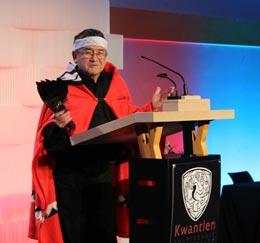
Kwantlen Polytechnic University (KPU) welcomed its first Elder in Residence at a special installation ceremony recently on January 29.
The university announceed Lekeyten, of the Kwantlen First Nation, would be holding this important role.
“In my travels, I have always been respectful of the teachings of people, and I’m always learning,” Lekeyten told the audience of friends, family and KPU faculty and staff. “I’m coming to join every classroom, and I’m going to learn as well.”
One of 20 Kwantlen First Nation Elders, Lekeyten grew up attending day school; similar to residential schools, day schools did not require students to stay overnight and they returned home at the end of every day.
But the teachings were the same, said Lekeyten, and he and his classmates were taught to be quiet. As a result, Lekeyten spent more time in nature than in school, and he soon found his voice.
Fast-forward to adulthood, and Lekeyten has been avidly involved for more than 20 years as a guest speaker and presenter at all levels of elementary, secondary and post-secondary education as well as trades and conferences in the Lower Mainland. His talks are about the environment, land and water use, fishing, and issues of conservation and its traditional importance.
His advice at the Elder in Residence installation ceremony: “Never shut up.”
The installation included warm remarks from many who have known and worked alongside Lekeyten.
Former KPU anthropology instructor Laura Cooper spoke of her lengthy friendship with Lekeyten. She said he taught her how to be a better instructor and a better human being – the latter lessons he also shared with students.
“I still get emails from students whose lives have been touched and these students are in their 40s.”
The primary focus of KPU’s Elder in Residence program is to support and encourage Aboriginal students on their educational journey. In his role, Lekeyten will share their knowledge, traditions and teachings with individual students and groups and will work with the university to encourage and promote understanding and respect for Indigenous perspectives, culture and values.
Add new comment