Salmon farming in B.C. began three decades ago and was developed by true pioneers who set a strong foundation of innovation and adaptation. Those working in this industry have always worked to grow healthy fish and make continuous improvements to ensure the long-term vibrancy of the ocean environment and marine wild species.
Like with any developing sector, there have been challenges. The progress of the industry has faced criticism as concern for the environment is entwined in the culture of B.C.
However, through innovation and adaptation, several important gains have been made over the past decade in specific areas of importance. The industry has become more mature and technically sophisticated, meaning it’s also more environmentally conscious than ever.
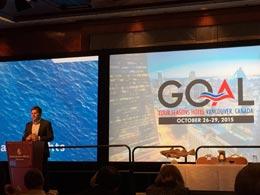
On Tuesday, October 27, the BC Salmon Farmers Association (BCSFA) launched their inaugural Sustainability Progress Report at the Global Aquaculture Alliance (GAA) GOAL conference, held at Vancouver’s Four Seasons Hotel.
Focusing on three core pillars of sustainability — environmental, social and economic — the report highlights the efforts of the industry to employ internationally recognized best practices and be global leaders in salmon farming.
The intent of the BCSFA’s Sustainability Progress Report is to show the industry’s commitment and progress, as well as the industry’s dedication to addressing issues that have been articulated.
“This past year the industry has advanced its commitments to marine research,” said Don Noakes, Dean of Science and Technology at Vancouver Island University (VIU) and appointed Chair of an independent Science Advisory Council leading the industry’s Marine Environmental Research Program. “First by completing a series of workshops that identified areas of priority, and second by appointing an independent Science Advisory Council and committing $1.5-million over the next five years to fund research the Council believes is relevant to furthering our understanding of the marine environment.”
The BCSFA report provides clarification and updates on a number of issues of public interest, detailing the importance of the salmon farming industry to the sustainability of BC’s coastal communities.
“The B.C. salmon industry has done a very good job with transparency, said Steve Hedlund, Communications Manager, GAA, referring to the report and the work of the BCSFA. “A lot of companies in the seafood sector are becoming more transparent, but if you’re not proactive about it then no one will necessarily know what you’re up to. Reports like this help to proactively push transparency.”
Placing a focus in areas related to the environment and the health of farm-raised and wild fish, the report highlights several key areas of improvement.
Antibiotics use by B.C. salmon farmers has decreased 7-fold over the past decade and currently sits at approximately 50 grams of antibiotic prescribed per tonne of production. The B.C. salmon farming industry has also been recognized for its protocol to only use medicine to treat fish with existing health issues and only through the prescription of a veterinarian.
Companies are taking a number of proactive measures to manage sea lice numbers and mitigate potential issues. The report discusses the average number of salmon lice (Lepeophtheirus salmonis) on salmon farms over the past 10 years as well as the proactive measures taken to manage sea lice for the health of both farm-raised and wild fish.
Salmon feeds used in B.C. contain less than 18 per cent marine-based products (fishmeal and oil). Feed producers have made noticeable changes to the composition of oils and proteins used in their feeds, replacing marine oil and protein sources with plant and animal sources.
Shifting gears to social and economic sustainability, salmon farmers contribute to the success of B.C.’s coastal communities, which includes building lasting partnerships within the communities they operate in.
For example, 78 per cent of the salmon raised in B.C. is done so in partnership with First Nations. Collectively, salmon farming companies in B.C. currently have 19 economic and social partnerships with First Nations, and are working towards many more.
Furthermore, in 2013, about $600,000 was donated by salmon farming companies to community organizations and causes.
Jeremy Dunn, Executive Director of the BCSFA, commented on the progress the organization has made towards ensuring the sustainability of BC’s coastal communities and the salmon farming industry.
“All of the issues have not been solved, but the resolve and commitment to get there is genuine. It’s a progressive journey,” said Dunn. “Working together within operating communities, with First Nations, and with the global research and scientific community, our progress will continue.”
The full report is available online at bcsalmonfarmers.ca.
Facts for Sidebar
Salmon farming contributes about 5,000 jobs and over $1.1-billion to the B.C. economy every year.
All salmon raised by BCSFA members are certified by comprehensive third-party programs.
Salmon are the most efficient eaters of any farm-raised animal, taking an average 1.3kg of feed to increase the animal’s weight by 1kg.
Significant improvements have been made by feed development companies to replace marine oil and protein sources with plant and animal sources.
78 per cent of the salmon raised in B.C. is done so in partnership with First Nations.
In 2013, about $600,000 was donated by salmon farming companies to community organizations and causes.
Add new comment