By Laura Jones
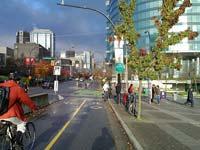
I ‘m choking back the urge to say “I told you so” to Vancouver city councillors who thought that taking out parking, restricting turns, and erecting concrete barriers to create a bike lane on Hornby Street would not hurt businesses.
The bike-lane impact study commissioned by the city found merchants on Hornby have experienced a sales decline of 10 per cent. The total loss in sales attributed to the Hornby and Dunsmuir bike lanes is $2.4 million. It cost about $4 million to build the lanes.
The report puts a rosy spin on the losses by referring to them as “moderate.” How many people would describe a 10-per-cent hit to their incomes as “moderate”?
The report points out that there were some “hot spots” where businesses fared worse. How much worse is left to the imagination.
The report includes some sensible recommendations. It suggests the city look at flexible approaches to sharing road space such as using automatic bollards that can be raised and lowered to establish a separated bike lane or to accommodate parking, depending on the circumstances.
Better consultation with affected parties before and after traffic changes are made is another suggestion.
As sensible as these suggestions are, the report sidestepped the most important question: What do you do when a public project has a serious negative impact on someone’s livelihood? While each Vancouver taxpayer footed a bit of the $4 million to build the lanes, is it fair to ask a small group to pony up a significant portion of their take-home pay?
The report goes as far as suggesting “that mitigation strategies be decided before construction begins.” That’s not far enough.
I have a challenge for the mayoral candidates for Vancouver: Be bolder than this report. Develop a set of guidelines to be followed for projects that disrupt business activity for more than a month.
The guidelines should include estimating the costs to small business owners and compensating them for a year’s worth of sales losses, or paying for moving costs. In other words, develop a plan that takes into account the full costs of these projects instead of loading much of the burden onto hardworking men and women who run small businesses and have families to support.
Seattle had a great model for its light-rail construction that included similar provisions. Mayor Gregor Robertson is familiar with it because he suggested it would have been the right approach when Cambie businesses suffered during construction of the Canada Line.
How would such a model have changed things on Hornby?
To keep costs down, council would have had a much stronger incentive to consider alternatives that would not have had such big impacts on business - a residential street, a Minneapolis-style lane that preserved parking and put the bike lane between the curb and the parked cars, or the bollards suggested in the bikelane impact study.
Some will argue that compensating small business is too expensive. If that’s true, it suggests the bike lanes weren’t really worth it in the first place.
Laura Jones, is the Sr. Vice-President Research, Economics & Western Canada with the Canadian Federation of Independent Business.
Add new comment