By Deanna Cheng
Local Journalism Initiative Reporter
Recessed balconies, red paper lanterns with yellow fringes, traditional Chinese script on glass windows... Chinatown of old was a hustling, bustling commercial hub where stores with wide awnings stretched over the sidewalk and any passerby could inspect rows of steamed buns or a cardboard box of dried powdery roots. Glowing neon lights drew the eye, leading customers to restaurants and bookshops.
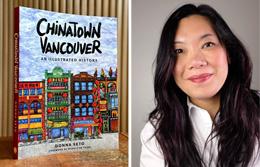
Part history, part art book, part nostalgia, Chinatown Vancouver: An Illustrated History reinvigorates a small, significant Vancouver neighbourhood with equal parts imagination and memory. Each careful colourful rendition of a building illuminates as if pulled from a child's mind. In between the paintings are brief histories, photos and interviews with community members.
This book fills a gap that's missing from the Canadian history classes that author and artist Donna Seto took in university.
"They merely taught us that the Chinese came to Canada to build the railway, and then the Head Tax was passed. The Chinese got a sentence, maybe a paragraph at most, notes Seto in a passage from her book.
She never saw herself in Canadian history nor in the politics she spent years studying. (Seto has a PhD in politics and international relations).
However, when looking into the details of Chinatown's history, she discovered an interesting generation in the 1960s and ’70s, a group of Canadian-born Chinese who were trying to find themselves.
They were from the first generation that was able to have the choice of not living or working in Chinatown. They were also trying to break away from their traditional parents.
This generation worked on what it meant to them to be both Chinese and Canadian.
"Moreover, having benefited from loosening geographic restrictions, the right to vote, and the ability to work in various professions, this generation tended to value upward mobility and integration into broader Canadian society," Seto writes.
Being able to learn from that generation and build upon that identity has been important to Seto. One of the lessons she learned about Chinatown is how adaptable people are.
Whether in conversations with people in Chinatown or her parents, there's a sense of willingness to adapt in their resilience, she says.
Chinatown is not a static monolithic place as presented in the media.
Chinatown Vancouver shares the perspective of a Chinese community that mourned, rebuilt and reinvented itself alongside other communities again and again for the last century or so.
Seto infused the energy of the Chinatown of her early childhood into her artwork.
"I wanted to imagine Chinatown with a brighter future, where the buildings aren't vandalized, where each shop had life instead of being empty and as a place people still depended on."
Seto grew up going to Chinatown with her parents where they could talk to others in the same dialect while doing their grocery shopping and banking with ease.
Her parents still don't really speak English, mainly Toisanese. They cannot read her book but they can look at the paintings and photos which start up conversations.
Chinatown is a lifeline for them. Seto’s parents continue to go there today for doctor visits and banking. When they come home, they talk about what's lost or changed.
Chinatown is still alive and dynamic, changing and evolving, but still present with new people, new memories and new experiences.
The book’s chapters on restaurants, grocers and the food ecosystem includes fun general food guides. Seto cherry-picked her favourite items and the general favourites among people she knows. The selection is personal. Infused with tidbits, Seto intended them as a highlight for Chinese Canadians and non-Chinese people who want to be educated.
With her meticulous research, Seto stitched pieces of the past together so it's easier to see historical patterns of discriminatory legislation — ranging from the Head Tax to the segregation of Chinese greengrocers from non-Chinese areas, to fining Chinese peddlers for delivering fresh fruits and vegetables to homes in horse-drawn carts and trucks.
Additionally, in the late 1920s and early ’30s, the province gave the BC Coast Vegetable Marketing Board the power to limit produce sales from Chinese farmers. This culminated to the point where the police barricaded bridges to keep Chinese farmers from delivering produce to wholesalers.
"When you do research on a place like Chinatown, you spend a lot of time asking questions,” Seto writes. “Where are the silences? Why are there silences?"
The privilege of recording history and major events into published books, especially here in North America, has been historically done by people who don't look like her and often grew up with certain privileges that she never had growing up, she adds.
The book briefly mentions Hogan's Alley, the historic Powell Street neighbourhood and Italian Canadians. Seto restricted the book to the geographic boundaries of Chinatown with a caveat that boundaries expanded and changed over time.
Historically, the representation of Chinatown assumed it was an isolated place, she says, and only Chinese people were ever allowed in or lived there. The truth is these communities were sometimes separated by alleys so Seto finds it hard to imagine they didn't interact. She adds they would've also worked together at various places like the railway, canneries, sawmills, etc.
If Seto was writing a bigger book about Vancouver's immigrant history, she would have expanded on the communities mentioned and include other ethnic groups such as the First Nations, Jews and Ukrainians.
But this work is a focused look at one vibrant, resilient neighbourhood, featuring more than 70 colourful illustrations, information about the buildings, archival photos, and interviews with community members. Chinatown Vancouver brings the contributions of the Chinese to Canada to life.
Chinatown Vancouver: An Illustrated History, by Donna Seto, was released in May and is on sale now. - Megaphone Magazine
Add new comment