Commentary|
By Jay Goldberg
Canadians voted for relative continuity in April, but investors voted with their wallets, withdrawing $124 billion from the country.
According to the National Bank, Canadian investors purchased approximately $124 billion in American securities between February and July of this year. At the same time, foreign investment in Canada dropped sharply, leaving the country with a serious hole in its capital base.
As Warren Lovely of National Bank put it, “with non-resident investors aloof and Canadians adding foreign assets, the country has suffered a major capital drain”—one he called “unprecedented.”
Why is this happening?
One reason is trade. Canada adopted one of the most aggressive responses to U.S. President Donald Trump’s tariff agenda. Former prime minister Justin Trudeau imposed retaliatory tariffs on the United States and escalated tensions further by targeting goods covered under the Canada–United States–Mexico–Mexico Agreement (CUSMA), something even the Trump administration avoided.
The result was punishing. Washington slapped a 35 per cent tariff on non-CUSMA Canadian goods, far higher than the 25 per cent rate applied to Mexico. That made Canadian exports less competitive and unattractive to U.S. consumers. The effects rippled through industries like autos, agriculture and steel, sectors that rely heavily on access to U.S. markets. Canadian producers suddenly found themselves priced out, and investors took note.
Recognizing the damage, Prime Minister Mark Carney rolled back all retaliatory tariffs on CUSMA-covered goods this summer in hopes of cooling tensions. Yet the 35 per cent tariff on non-CUSMA Canadian exports remains, among the highest the U.S. applies to any trading partner.
Investors saw the writing on the wall. They understood Trudeau’s strategy had soured relations with Trump and that, given Canada’s reliance on U.S. trade, the United States would inevitably come out on top. Parking capital in U.S. securities looked far safer than betting on Canada’s economy under a government playing a weak hand.
The trade story alone explains much of the exodus, but fiscal policy is another concern. Interim Parliamentary Budget Officer Jason Jacques recently called Ottawa’s approach “stupefying” and warned that Canada risks a 1990s-style fiscal crisis if spending isn’t brought under control. During the 1990s, ballooning deficits forced deep program cuts and painful tax hikes. Interest rates soared, Canada’s debt was downgraded, and Ottawa nearly lost control of its finances. Investors are seeing warning signs that history could repeat itself.
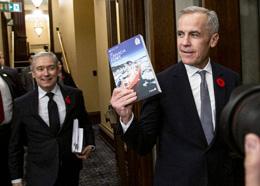
Carney’s long-delayed budget, released on Nov. 4, only deepened those concerns. Jacques had already projected a deficit in the low‑ $60‑ billion range, warning the outlook was “unsustainable.” Carney’s budget ultimately projected a deficit of $78.3 billion for 2025‑ 26, substantially higher than that forecast. And that doesn’t include Carney’s campaign promises, such as higher defence spending, which could add tens of billions more.
Deficits of that scale matter. They can drive up borrowing costs, leave less room for social spending and undermine confidence in the country’s long-term fiscal stability. For investors managing pensions, RRSPs or business portfolios, Canada’s balance sheet now looks shaky compared to a U.S. economy offering both scale and relative stability.
Add in high taxes, heavy regulation and interprovincial trade barriers, and the picture grows bleaker. Despite decades of promises, barriers between provinces still make it difficult for Canadian businesses to trade freely within their own country. From differing trucking regulations to restrictions on alcohol distribution, these long-standing inefficiencies eat away at productivity. When combined with federal tax and regulatory burdens, the environment for growth becomes even more hostile.
The Carney government needs to take this unprecedented capital drain seriously. Investors are not acting on a whim. They are responding to structural problems—ill-advised trade actions, runaway federal spending and persistent barriers to growth—that Ottawa has yet to fix.
In the short term, that means striking a deal with Washington to lower tariffs and restore confidence that Canada can maintain stable access to U.S. markets. It also means resisting the urge to spend Canada into deeper deficits when warning lights are already flashing red. Over the long term, Ottawa must finally tackle high taxes, cut red tape and eliminate the bureaucratic obstacles that stand in the way of economic growth.
Capital has choices. Right now, it is voting with its feet, and with its dollars, and heading south. If Canada wants that capital to come home, the government will have to earn it back.
Jay Goldberg is a fellow with the Frontier Centre for Public Policy.
Budget 2025 Takeaways
• Big spending paired with deep cuts. The Carney government is rolling out C$280bn in new spending, pushing the deficit toward C$78.3bn, one of the largest in Canadian history. The money will go into highways, ports, power grids, digital infrastructure, defence and productivity initiatives. At the same time, Ottawa is planning C$60bn in cuts over five years, including reducing the federal workforce by 40,000 positions through attrition and automation. Ministries could see up to 15% reductions, with the budget drawing a new line between day-to-day operational spending and longer-term capital investments aimed at economic growth.
• Pivot away from reliance on the US market. The budget signals a deliberate shift to reduce Canada’s trade exposure to the United States, which still accounts for 70% of exports. Ottawa wants to double non-US exports over the next decade, offering new funding to help businesses break into Europe and Asia. Measures include lowering Canada’s marginal effective tax rate to 13.2%, below the US, while investing C$1.3bn to attract international researchers to Canadian universities. There is even talk of leveraging cultural ties, such as exploring participation in Eurovision, to deepen European engagement.
• Push to become a clean energy leader. The government is promoting a “clean energy superpower” strategy to expand low-carbon LNG, nuclear technology, and carbon capture systems, alongside more stringent methane rules. The plan replaces the previous government’s oil and gas emissions cap but keeps the industrial carbon tax, positioning it as essential for long-term emissions reductions. Ottawa says stabilizing carbon pricing will help companies make multi-year investment decisions and strengthen Canada’s competitive footing as global markets decarbonize.
• A major defence overhaul. Defence spending will rise sharply to meet NATO’s 2% of GDP target this year, with a path to 5% by 2035, driven by concerns over Russia, China and Arctic security. The budget commits C$81.8bn over five years to the Canadian Forces, including pay increases, digital modernization and domestic supply chain development. Another C$1bn is earmarked for dual-use Arctic infrastructure, and C$182.6m will go towards building space-launch capabilities.
• Clear departures from Trudeau-era policies. Carney is undoing several priorities of the previous government: the consumer carbon tax is gone, the EV sales mandate delayed, and the capital gains tax hike is cancelled. Immigration policy is also being reshaped. Temporary resident admissions fall from 673,650 to 385,000 next year, then to 370,000 in 2027–28, though 33,000 temporary workers will be fast-tracked to permanent residency. The 2 Billion Trees program is being scrapped, and the luxury tax on high-priced cars, planes and boats is being eliminated after costing more to administer than it generated.
• Support for industries hit by US tariffs. With the US imposing broad 35% tariffs and targeted levies on steel, lumber, autos and aluminum, Ottawa will spend C$5bn to help affected sectors adapt. A C$10bn loan facility will support firms facing temporary strain, starting with Algoma Steel. A Buy Canadian procurement policy is being introduced to keep more production at home. Funding will partly come from C$6.5bn Canada has collected through its own counter-tariffs.
Add new comment