By Kashif Raza
The Conversation
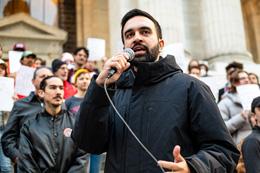
When Zohran Mamdani campaigned for New York City mayor, he didn’t sound like a typical American politician, speaking only English at his rallies and public appearances.
Instead, he switched between Arabic, Bangla, English, Hindi, Luganda, Spanish and Urdu to connect with diverse communities. He also made appearances on transnational media outlets to discuss issues that crossed borders.
I am a post-doctoral fellow at the University of British Columbia, studying the integration patterns of immigrants and how they’re shaped by the intersection of language, ethnicity and migration.
For me, Mamdani’s story is more than a local success. It signals how politics is being reshaped by migration and multilingualism and how language itself has become a foundation of belonging in diverse democracies.
Mamdani’s campaign began with a simple but powerful line:
“It’s time to take back our power and unleash the public sector to build housing for the many.”
This message resonated across the city’s working-class neighbourhoods — taxi drivers, nurses, delivery workers and students, many of them immigrants trying to make ends meet. What made it even more effective was how he delivered it: not just in English, but in the many languages New Yorkers speak.
He repeated his call for affordability and fairness in Arabic, Bangla, Urdu-Hindi, and Spanish. His campaign videos and flyers mixed languages the way people do in everyday life, switching easily between English and the languages of home.
This was about more than translation; it was about recognition and connection with people.
New York is one of the most linguistically diverse cities in the world, with more than 800 languages spoken. Nearly 35 per cent of its residents are born outside the United States.
Mamdani understood that voters don’t leave their languages behind when they migrate. They use them to make sense of work, community and politics. By speaking to them in those languages, he showed that their voices mattered in shaping the city’s future.
This approach reflects what scholars of migration linguistics — the study of how language and mobility shape one another in the process of migration, settlement and belonging — describe as multilingual political integration.
It is a way migrants connect identity to civic participation. Mamdani’s campaign turned that bridge into a political strategy: one that viewed multilingualism not as an obstacle to democracy, but as its living proof.
It also serves as a quiet reality check on the long-standing “melting pot” ideal in the United States, which assumes immigrants must shed their languages and traditions to blend into a single American identity.
Mamdani’s multilingual strategy also reflected the transnational reality of modern migration. His Urdu interview on Pakistan’s Geo News and his criticism of India’s Narendra Modi during conversations with Indian-origin voters in the U.S. blurred the line between domestic and global audiences.
These appearances were not campaign gimmicks; they acknowledged that diaspora communities are shaped by more than one national story.
Migration linguistics helps explain this dynamic. It studies how language practices move across borders and connect places of origin, settlement and diaspora. In Mamdani’s case, multilingual communication created what scholars call transnational publics — shared spaces of conversation that stretch from New York to Karachi and Delhi.
When a politician addresses issues such as Islamophobia, immigration or housing in multiple languages, they are not only appealing to voters at home. They are engaging with a wider world of shared experiences that migration has woven together.
Language was only part of Mamdani’s strategy. His campaign also used cultural expression — food, music and festivals — as forms of communication.
From Iftar gatherings during Ramadan to Diwali celebrations and South Asian street fairs, these events became spaces of multilingual interaction where taste, sound, and ritual carried political meaning.
Migration linguistics views such practices as intercultural competence: the use of cultural forms to express belonging and solidarity.
Mamdani’s campaign showed that civic participation doesn’t only happen in speeches or debates; it also happens in shared meals, songs and celebrations that remind people they belong to the same city.
Mamdani’s brand of of politics holds lessons for Canada. Since I wrote on this topic earlier this year, immigrant and racialized voters are already changing how campaigns are organized and how communities mobilize.
Canada’s largest cities, in particular Toronto and Vancouver, are among the most linguistically diverse in the world. Yet a lot of political outreach still assumes an English- or French-only audience.
Mamdani’s campaign suggests another path. By engaging multilingual voters through their languages, stories and digital networks, politicians can build deeper, more authentic relationships.
It’s time for Canadian politicians to move beyond teleprompters and translators and learn and use minority languages as a genuine way to connect with multilingual voters as they make up a significant portion of the electorate.
Kashif Raza is a Postdoctoral Fellow, Faculty of Education, University of British Columbia.
A Look at Multilingual Canada
• Canada is one of the most multilingual countries in the world, with extensive diversity in both official and non-official languages. Over 200 languages are spoken as mother tongues, and multilingualism is continuing to grow, especially due to immigration and linguistic diversity within communities.
Number of Languages Spoken
• More than 200 different languages were reported as a mother tongue in the 2021 census, with at least 18 of these having 100,000 or more first-language speakers.
• English and French are the two official languages, spoken by the vast majority (at least 98.1%) of Canadians.
• The most common non-official mother tongues are Mandarin (679,000), Punjabi (667,000), Yue/Cantonese (553,000), and Spanish (539,000).
Official Languages and Bilingualism
• About 22% of Canadians speak French as their first official language, and 76% speak English as their first official language.
• The proportion of Canadians who are bilingual in English and French is 18%, with higher rates—over 46%—in Quebec.
• 98.1% of the total population can converse in either English or French.
Multilingual Households and Population
• More than 3.1 million households, or 21% of Canadian households, are multilingual, meaning at least two languages are spoken at home.
• Over 41% of Canadians reported being able to converse in more than one language in the 2021 Census, a rise from 39% in 2016.
• 12.7% of the Canadian population speak a language other than English or French at home, up from 7.7% in 1991.
• Roughly 7% of Canadians said they could speak three languages fluently, with higher trilingual populations in Quebec and Nunavut.
Indigenous and Sign Languages
• Over 70 Indigenous languages are spoken in Canada, with Cree languages being the most prevalent—around 86,480 speakers.
• Nearly 50,000 Canadians reported knowing a sign language, and about 28,000 use it regularly at home.
Canada's linguistic landscape continues to evolve rapidly, illustrating a pronounced trend toward multilingualism, driven by immigration, cultural diversity, and education policies.
Add new comment