By Fabian Dawson
New Canadian Media
In an election most Canadians do not want, nobody got anything of substance from political leaders who clashed against one another in last week’s only English-language television debate.
Hyped as a pivotal moment for undecided voters in the final stretch of the campaign, the crucial issue of immigration or challenges faced by newcomers got no airtime.
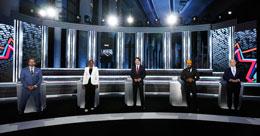
Conservative Leader Erin O’Toole, NDP Leader Jagmeet Singh, Green Party Leader Annamie Paul and Bloc Quebecois Leader Yves-Francois Blanchet all attacked Liberal Leader Justin Trudeau for calling an election during a pandemic and the Afghanistan crisis.
Trudeau, appearing agitated and taking fire from all sides, did not muster much of a response other than saying Canadians must “make a choice” about which leaders’ plan is best for the future.
“I’m still undecided after watching the debate because I don’t think there was that one moment that was a game-changer,” said Paula Arab, a Vancouver-based media and communications strategist, who is an undecided voter.
“Overall, the one who seemed most prime ministerial was O’Toole, while Trudeau was desperate. Beyond that, there wasn’t enough substance to really make an informed decision,” she said.
The two-hour debate covered five themes – affordability, climate, COVID recovery, leadership and accountability/reconciliation – and was moderated by Shachi Kurl, president of the Angus Reid Institute, with the participation of journalists Rosemary Barton, Melissa Ridgen, Evan Solomon, and Mercedes Stephenson.
Kurl had to preside over a format decided upon by the Debate Broadcast Group, which resulted in chaotic cross-talk, party leaders interrupting each other with prepared one-liners and little in the way of substantive discussion on what matters most to Canadians.
“This moderator did a great job keeping the leaders in line and on topic. She ran a tight ship,” said Arab.
Alex Martyniak, the executive director of the EU Chamber of Commerce in Canada – West, said Kurl stood out the most among all those on stage.
“One would hope one day she will stand on the other side answering the questions,” he said.
Kurl, however, came under fire from Bloc Quebecois’ Blanchet for her opening question directed at him about Quebec’s Bill 21 “secularism” law which restricts the wearing of ‘religious symbols’ by public servants in positions of authority such as teachers, police officers, judges, and lawyers.
Blanchet, bristling at the question, answered that “those laws are not about discrimination, they are about the values of Quebec,” and then went on to say “you may repeat as many times as you like that those are discriminatory laws,” before adding later that he has no interest in leading Canada.
The question and response has given Blanchet’s Bloc Quebecois, a regional party that wants Quebec to be recognized as a nation, a much-needed wedge issue to portray themselves as the protectors of the people of Quebec.
Current polls have suggested Trudeau’s Liberals could take as many as 41 Quebec seats, an increase from the 35 seats they won in the 2019 election.
“The Bloc will likely benefit from this exchange, as it wants a minority government to give it more autonomy,” said Gurmant Grewal, a former Conservative MP, who represented the Surrey riding of Fleetwood—Port Kells from 2004 to 2015.
Rating the performance of the leaders in the debate, Gurpreet Singh, a South Asian radio talk show host and political commentator said Trudeau portrayed a lack of confidence in his answers while O’Toole remained calm during the debate and came across as a reasoned politician.
“Singh and Paul did a far better job than I expected and brought a different dynamic to the leadership debate being from visible minority backgrounds.
“Paul should also get credit for taking on everyone on issues of systemic racism and reconciliation, including the so-called progressives like Singh and Trudeau, but they were better when answering questions coming from voters directly,” he said.
Beyond the fiery exchanges, one other name stood out in the debate.
Many of the leaders referred to Jody Wilson-Raybould, who served as justice and veterans affairs minister before being expelled from the Liberal caucus following the SNC-Lavalin scandal in 2019.
Wilson-Raybould, who has become a fierce critic of the government and sat as an Independent following her expulsion from the Liberal Party, is not running for re-election.
Paul mentioned Wilson-Raybould to challenge Trudeau’s self-proclaimed identity as a feminist while O’Toole referenced her when talking about building partnerships with First Nations.
Wilson-Raybould’s book – “Indian” in the Cabinet: Speaking Truth to Power – comes out this and is expected to provide fodder to attack Trudeau’s record in the stretch run to polling day on Sept 20.
Political analysts across the country, U.K. and the United States, whose punditry dominated post-debate analyses on news feeds, said the exchanges between the leaders did not give Canadians much in the way of substance to sway the undecided voter. They mostly agreed that the format needed to change.
The absence of any discussion on immigration policies, the opioid crisis and issues pertaining to New Canadians, who form the largest voting bloc in more than 40 of 338 federal Parliamentary ridings, was a lost opportunity, said a Victoria-based political analyst, working for the BC government.
Add new comment