By Fabian Dawson,
New Canadian Media
Canada is pledging to spend over two billion dollars over the next five years to fix and maintain its immigration system, which is currently jammed with a backlog of close to two million applications.
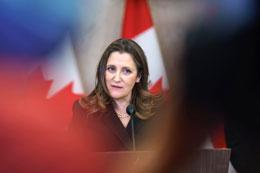
Finance Minister Chrystia Freeland, in unveiling the 2022 Budget today, said the fiscal package is aimed at countering global uncertainties caused by the pandemic and the Russian invasion of Ukraine, which has triggered a mass exodus of four million refugees.
Overall, Freeland’s second pandemic budget includes more than $31 billion in new spending over the next five years and forecasts a 3.9 percent economic growth this year.
“Throughout the pandemic, many newcomers have been on the front lines, working in key sectors like health care, transportation, the service sector, and manufacturing. Without them, Canada’s economy would not have overcome the challenges of the last two years,” she said.
“At a time when the world is starved for workers and talent, our country’s unique enthusiasm for welcoming new Canadians is a powerful—and particularly Canadian—driver of economic prosperity.
“This Budget will make it easier for the skilled immigrants that our economy needs to make Canada their home, and to do the jobs they are trained for,” said Freeland.
Prior to the budget, Canada announced that it aims to continue welcoming immigrants at a rate of about one percent of the nation’s population. This includes 431,645 permanent residents in 2022 (an increase of about 21,000 people from its original plan), 447,055 in 2023, and 451,000 in 2024.
Immigration and refugee-related spending in Budget 2022, includes:
$385.7 million over five years, and $86.5 million ongoings, for Immigration, Refugees and Citizenship Canada (IRCC), the Canada Border Services Agency (CBSA), and the Canadian Security Intelligence Service (CSIS) to facilitate the timely and efficient entry of a growing number of visitors, workers, and students.
$1.3 billion over the next five years, and $331.2 million ongoing, to support the long-term stability and integrity of Canada’s asylum system.
$43.5 million in 2022-23 to maintain federal support for immigration and refugee legal aid services.
$187.3 million over five years, and $37.2 million ongoing, for IRCC to invest in the technology and tools required to better support people using their services.
$115 million over five years, with $30 million ongoing, to expand the Foreign Credential Recognition Program and help up to 11,000 internationally trained health care professionals per year get their credentials recognized and find work in their field.
$29.3 million over three years to introduce a Trusted Employer Model that reduces red tape for repeat employers of foreign workers.
$48.2 million over three years, with $2.8 million in remaining amortization, to implement a new foreign labour program for agriculture and fish processing operations.
$64.6 million over three years to increase capacity to process employer applications within established service standards, and
$14.6 million in 2022-23, with $3 million in remaining amortization, to make improvements to the quality of employer inspections and hold employers accountable for the treatment of workers.
The Canadian Immigration Lawyers Association (CILA) said it is encouraged by the Government’s commitments in Budget 2022 to investing in improvement to service delivery.
“We are pleased to see these commitments, including the dedication of funding to improve service standards to process temporary foreign worker applications,” said CILA spokesperson Betsy Kane.
“These commitments will help alleviate labour shortages across all sectors of the economy and improve the client experience,” she told NCM.
The Ottawa-based lawyer said the plan to fine-tune the selection criteria for economic immigrants will allow the government to meet its ambitious immigration targets and fill labour shortages across a range of skills, including in those occupations essential to sustaining our economy and well-being.
“Access to immigration and refugee legal aid services across Canada is extremely limited and we applaud the increased support for legal aid services for both refugee and immigration matters,” she said.
“The introduction of an electronic application system to file asylum claims will allow refugee lawyers to focus on the helping clients prepare for hearing.
“CILA also looks forward to learning more about our government’s commitment to opening new pathways for permanent residence status for Ukrainian citizens seeking a haven in Canada,” said Kane.
Lisa Lalande, CEO of Century Initiative, which advocates for policies to increase Canada’s population to 100 million by 2100 said today’s budget acknowledges the need to continue taking steps to attract, process, settle and integrate immigrants into Canada.
“Canada’s birth rate is at its lowest in more than a century, making immigration all the more important to the country’s long-term prosperity,” she said in an emailed statement to NCM.
“While there is much work to be done to achieve the goal of a bigger, bolder Canada, Budget 2022 signals a strong commitment from our government, and we look forward to working with them.”
Other key Budget 2022 highlights
$4 billion over the next five years to launch a new fund in the Canada Housing and Mortgage Corporation to help cities and municipalities create more affordable housing, and $1.5 billion over two years to the CMHC's Rapid Housing Initiative to create 6,000 new affordable housing units with at least one-quarter of the funding dedicated to women-focused projects.
$625 million over four years, starting in 2023-24, for child care, to help the provinces and territories build new facilities and make new investments. The new funding is a followup to the various federal child-care agreements with the provinces and territories after they raised concerns that non-profit and public providers were facing soaring real estate and building material costs.
$1 billion over five years, starting in 2022-23, to create an independent federal innovation and investment agency. The measure is designed to spur economic growth and address the fact that Canada is ranked last in the G7 in spending on research and development by business.
The defence budget got new money with more than $8 billion pledged over five years to better equip the Canadian Armed Forces, reinforce cybersecurity and support a culture of change. The budget contained no road map on whether this would be enough to boost Canada's defence spending to the NATO target of two percent of GDP, as the alliance works to bolster Europe following the Russian invasion of Ukraine.
Add new comment